The bagua map is a feng shui tool used to map out the various energy areas of your home. The bagua map reveals which rooms fall into these different sectors/quadrants and which areas of your life they affect.
Two Types of Bagua Maps
The bagua is divided into eight sectors. These eight sectors radiate from the center of the bagua and correlate to eight compass direction. The bagua can be used either as its original octagon shape or as a nine-square grid.
The two main schools of feng shui use different versions of the bagua when determining these sectors. Classical Feng Shui uses the octagon bagua for this purpose, while Black Hat Feng Shui (BTB) uses the nine grid square. Classical Feng Shui uses compass readings to determine where to overlay the bagua on a layout of your home. BTB Feng Shui doesn't use compass readings and applies the bagua gird the same way for every home or office, regardless of the compass directions. BTB feng shui refers to the grid as a symbolic bagua map, and is fashioned after the traditional feng shui lo shu square.
Both schools of feng shui use the same remedies and cures for any sector/quadrant negatively impacting your life. The feng shui remedies can transform the negative energy by attracting auspicious chi energy.
BTB and Classical Feng Shui Bagua Map Differences
Unlike where compass readings for the sitting and facing directions govern the use of the bagua, Black Hat ignores the magnetic compass directions of the home. The BTB grid bagua map, unlike the Classical, is a square comprised of nine equal-sized, smaller squares.
How to Use the BTB Bagua Grid Map
If you follow the BTB school of feng shui, then you'll use the square BTB Bagua.
Step 1: Sketch Your Home's Layout
You will need to sketch the layout of your home. You want to scale-to-size each room in your home is accurately as you can draw, but don't worry if it is off a little, you'll still be able to identify where each sector/quadrant is in your home.
- Indicate the front door, all exterior and interior doorway, and all windows in your drawing/layout.
- Draw or indicate all the furniture placements.
- Indicate where the kitchen appliances are located.
- Note any structural features like a staircase, outside patio, porch, or deck.
Step Two: Print the BTB Bagua Chart
Print the bagua map below using Adobe Reader. The BTB bagua grid map is placed over a layout of your home.

Step Three: Align the BTB Bagua Map With Your Floor Plan
You will superimpose the bagua map over your layout. In BTB feng shui, the South Sector of the bagua map is always placed at the top of a layout. This means that the bottom (North Sector) of the BTB bagua map will fall over the front side of your home layout.
Step Four: Note Front Door Quadrant
Once you have the overlay placed over your layout, you will notice the front door falls into one of three quadrants along the bottom of the layout. While the north direction defines the front of your home, your front door may fall in the N, NE or NW quadrant. Your front door could open in the education quadrant, career quadrant, or the mentor quadrant.

Step Five: Adjust BTB Bagua Grid to Fit Your Layout
You will only use the BTB bagua grid over the parts of your home that are covered by a roof. You may need to adjust the Bagua grid to fit your layout. You can expand the square either up or sideways in order to create a square over your home layout. The grid squares should always be even and the same size. You should end up with a big square shape overshadowing your home layout.
Step Six: Adjust for Irregular House Layouts
If your home isn't a perfect square or rectangle, you can still use the BTB bagua to identify the areas of your life impacted by the map energies. If you have what's known as missing corners, don't panic, there are feng shui remedies to help.
A missing corner is any part of your home that doesn't fall inside the square grid. For example, if your home is an L-shape, you'll still place the bagua over the missing areas so it forms a large square.
You'll create an imaginary corner for that part of your house that is missing and place the bagua over it. You can use a missing corner feng shui remedy to anchor the chi energy in this area. A few ways to do this is to create a symbolic physical corner. If you choose a lighting remedy, you'll need to leave the light one for a minimum of six hours daily. A few examples include:
- Plant a grouping of one or three tall shrubberies.
- Create a flower bed in the missing corner.
- Place a landscaping floodlight to shine from the missing corner, directing the light toward your house.
- Install a lamp post.
- Set a large rock in the missing corner space.
An extended area of a room, such as an enclosed sunroom off of a den, or a screened-in porch isn't usually negative. In fact, an extended area of a home usually means you have more of the energy in that grid. For example, if the extension is in the wealth sector, then you will have greater wealth.
Step Seven: Use Feng Shui Elements to Activate Chi
You can now use the map to help strengthen various areas of your life, such as career, money, relationships, health, and more. Begin by familiarizing yourself with each quadrant of the BTB bagua and how it relates to the room(s) of your home.
Influences of BTB Bagua Map Sectors
For Western Feng Shui, BTB, you can use the bagua map sectors for the correlating colors, elements, element suggestion, and location on the bagua grid. Each quadrant features one or more examples of the element you can use to activate the auspicious chi energy. You can also apply the feng shui remedies given should any of the nine grids be afflicted. Each listing gives the quadrant location on the BTB bagua map.
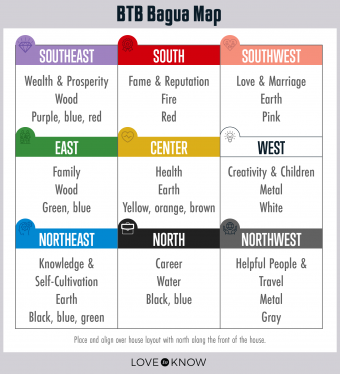
Fame & Reputation
- Fire: Candles, wood
- Color: Red
- Location: Rear middle
Love & Marriage
- Earth: Crystals, pottery, or ceramics
- Color: Pink
- Location: Right rear
Creativity & Children
- Metal: Metal objects, especially round ones
- Color: White
- Location: Right middle
Helpful People & Travel
- Metal: Metal objects
- Color: Gray
- Location: Front right
Career
- Water: Aquarium, water fountain
- Color: Black or blue
- Location: Front middle
Knowledge & Self-Cultivation
- Earth: Crystals, pottery, or ceramics
- Color: Black, Blue, Green
- Location: Front left
Health & Family
- Wood: Plants, wood furniture
- Color: Green, blue
- Location: Middle left
Wealth & Prosperity
- Wood: Plants, wood furniture
- Color: Purple, blue, red
- Location: Rear left
Center
- Earth: Crystals, pottery, or ceramics
- Color:" Yellow, orange, brown
- Location: Center
Classical Feng Shui Bagua
If you practice Classical feng shui, you will use the traditional octagon bagua for your rooms. You will place the bagua map according to your compass reading.
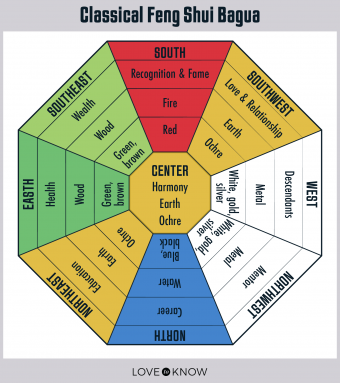
South Sector
The Chinese believe that south is the most auspicious direction, so this direction of the bagua is located at the top and placed over your home layout in this manner.
- Represents: Fame and recognition
- Element: Fire
- Activate: Candles, fireplace, lamps
- Color: Red, orange, mauve, or pink
The luck factor activates recognition and can stimulate career promotions and growth. Place awards, degrees, and other symbols of your achievements in this sector of your home. Add floor and table lamps to further activate the fire element.
Southwest Sector
The southwest can be activated to help you in all types of relationships.

If you are seeking love and romance, add earth elements to activate this sector. Use a natural crystal, lamp, or clay pottery. There are several feng shui symbols you can use, such as the double happiness emblem, rose quartz, amethyst crystal or a ceramic pair of Mandarin ducks. Reinforce relationships with photos of loved ones, especially a wedding photo for married couples.
West Sector
The west oversees your descendants' luck. If your children have challenges or difficulties in their lives, you can assist them by activating this sector.
- Represents: Descendants (children)
- Element: Metal
- Activate: Metal art objects, crystal
- Color: Yellow, ochre, gold, pewter, copper, brass or silver
You can activate this sector by using metal photo frames for pictures of your children. Use a grouping of nine for the ultimate feng shui luck factor. Nine is the number of longevity and success.
Northwest Sector
This is the sector for mentor luck. The northwest sector can assist you in finding someone to help you learn a new skill or craft or impart knowledge you seek.
- Represents: Mentor and helpful people
- Element: Metal
- Activate: Metal objects, crystal
- Color: Yellow, ochre, gold, pewter, or silver (all metal colors)
If you are in need of an influential person's assistance or a patron, then select a metal object or wall art for this sector of your home. A six-rod wind chime is an excellent choice. You can use other symbols of victory and success. A well-known expert in your field can be represented with a related book or article placed in this sector.
North Sector
The north oversees careers. If you're having difficulty advancing your career or need an extra boost for a project, activate this sector.
- Represents: Career
- Element: Water
- Activate: Fountain or aquarium
- Color: Black or blue
One of the fastest ways to activate your career luck is to place a water fountain in this sector. Make sure the water flows into the room and not out of it. An aquarium is another great tool for activating the water element. For optimum success, use the lucky number of fish for the tank - eight red fish and one black fish. The black fish will deflect negative chi. Keep the aquarium clean and replace any dead fish immediately.
Northeast Sector
The northeast governs education. While academic education falls under this sector, other forms of education are also included, such as on-the-job training or independent studies. If you need a better education or if you are studying for an exam or licensing, then activate this sector.
- Represents: Education
- Element: Earth
- Activate: Crystal, pottery
- Color: Ochre
Activate this sector with a crystal or bright light. Use symbols of education, such as a globe, textbooks and other objects. If possible, turn this sector into a study area with a desk, chair, and task light.
East Sector
This sector is often neglected because many people place emphasis on career, love, and money. If you don't have good health, none of the other things will matter. This sector also rules growth and, of course, longevity.
- Represents: Health
- Element: Wood
- Activate: Water feature, plants, wood objects
- Color: Green or brown

You can activate this sector with lush plants, such as a jade plant and others with round or oval leaves. These shapes symbolize coins. Avoid plants with pointed leaves since these create poison arrows. A lucky bamboo plant is an excellent symbol of health. Other objects include an iconic peach, wood furniture, water fountain, or aquarium.
Southeast Sector
This sector controls your wealth or prosperity luck. Activate this sector to stimulate greater income and overall family.
- Represents: Wealth
- Element: Wood
- Activate: Water features, plants
- Color: Green, brown
Like the east sector, the southeast element is wood and can be activated by the same methods. You can also use symbols of wealth, such as coins, gold ingots, and wealth ships or jars.
Center Sector
This sector is the center of balance or yin yang. The center of your home radiates to all other sectors and is vital to auspicious chi in a home.
- Represents: Balance (yin yang)
- Element: Earth
- Activate: Crystal, pottery
- Color: Yellow
Like the northeast and southwest sectors, you can use crystals or pottery to activate the earth element. You can also use symbols of balance, such as a framed yin yang drawing or other depiction of this ancient symbol of balance.
Activate Auspicious Chi in Your Life
These are just a few of the many symbols and objects you can use to activate each sector. The bagua map used in Black Hat Sect feng shui can aid you in attracting the benefit of auspicious chi energy for these areas of your life.